
Travel coordination is the single most important logistical decision a couple makes when planning a destination wedding. Without it, guests miss flights, transfers fall apart, and vendors arrive late or not at all. The good news is that early, structured planning solves nearly every one of these problems before they start. Whether you are planning a ceremony at a Cancun resort or a beachfront celebration in Punta Cana, understanding why destination weddings need travel coordination is the first step toward a wedding day that actually goes as planned.
Why destination weddings need travel coordination more than local weddings
Destination wedding logistics are fundamentally different from planning a local ceremony. A local wedding asks guests to drive across town. A destination wedding asks them to request vacation time, book international flights, arrange passports, and navigate an unfamiliar airport in a foreign country. That gap in complexity is why travel coordination is not optional. It is the architecture that holds the entire event together.

Guest attendance rates reach 75–80% when couples communicate logistics early and clearly. That number drops sharply when guests receive vague information or short notice. The difference between a full celebration and a half-empty ceremony often comes down to how well travel details were communicated and managed.
The industry standard for destination weddings sets the RSVP deadline at 4–6 months before the wedding date. That is double the timeline required for a local wedding. The reason is simple: guests need time to book flights, arrange accommodations, and plan their travel budgets. Couples who skip this structure consistently report higher no-show rates and last-minute cancellations.
Resorts in the Caribbean and Mexico, including popular venues in Los Cabos, Riviera Maya, and the Dominican Republic, each have their own airport proximity, transfer policies, and group booking rules. A couple planning at Hilton La Romana in the Dominican Republic faces completely different logistics than one planning at a Cancun all-inclusive. Travel coordination accounts for those regional differences from the start.
What are the unique travel logistics challenges in destination weddings?
Destination weddings introduce a set of logistical challenges that most couples do not anticipate until they are already deep in the planning process.
- Staggered flight arrivals: Guests fly in from multiple cities on different airlines and arrive at different times. Without a coordinated transfer plan, each guest is on their own from the airport to the resort.
- Group hotel blocks: Securing a room block requires negotiating directly with the resort, setting a booking deadline, and communicating the process to every guest. Blocks that expire before guests book result in higher room rates and scattered accommodations.
- International travel documentation: Guests traveling to Mexico or the Caribbean need valid passports, and some nationalities require visas. Couples must communicate these requirements clearly and early.
- Vendor travel costs: Bringing home-based vendors to a destination wedding costs between $2,000 and $4,000 in travel expenses alone. Local vendors eliminate that cost and typically bring stronger regional expertise.
- Airport transfers: Transfers from the airport to the resort are rarely included automatically at international resorts. Guests who are not informed in advance often face long waits, high taxi fees, or no transportation at all.
The airport transfer issue is one of the most overlooked problems in destination wedding planning. A guest landing at Punta Cana International Airport with no arranged transport and no local knowledge is a guest who arrives stressed, late, and frustrated before the celebration even begins.
Pro Tip: Send a detailed travel guide to every guest alongside your save-the-date. Include airport codes, transfer options, resort check-in details, and a direct contact for questions. This one document eliminates the majority of guest confusion.
Couples planning in the Caribbean and Mexico should also account for seasonal flight schedules. Some routes to smaller regional airports operate on limited days. A guest trying to fly into Puerto Plata on a Thursday may find no direct options and need to connect through Santo Domingo. Knowing this in advance lets you advise guests before they book the wrong itinerary.
How does professional travel coordination improve destination wedding outcomes?
Professional travel coordination transforms destination wedding planning from a reactive scramble into a managed process. The benefits are concrete and measurable.
- Centralized guest communication. A travel coordinator manages all guest inquiries about flights, accommodations, and transfers. Couples stop fielding 40 individual text messages asking the same questions.
- Booking deadline management. Travel coordinators handle booking deadlines and send reminders to guests who have not yet secured their rooms or flights. This directly improves attendance rates.
- Negotiated group rates. Coordinators unlock group discounts and complimentary perks that individual guests cannot access on their own. These perks often include room upgrades, welcome amenities, and discounted excursion packages.
- Airport transfer coordination. A coordinator arranges ground transportation for every guest, matching arrival times to shuttle schedules. No one is left waiting at the curb.
- Vendor liaison. The coordinator acts as the connection point between the resort, the wedding planner, and any outside vendors. When a florist’s shipment is delayed or a photographer needs a room, the coordinator handles it without pulling the couple away from their day.
- Last-minute problem solving. Flight cancellations, delayed arrivals, and room assignment errors happen at every destination wedding. A coordinator absorbs those problems and resolves them before the couple even knows they occurred.
The financial case for professional coordination is equally strong. Couples who secure negotiated group rates on hotel blocks often recover the cost of the coordinator’s fee through savings alone. Add in the avoided cost of vendor travel by using local destination specialists and the math becomes even clearer.
Pro Tip: Ask your travel coordinator for a single master itinerary document that covers every guest’s arrival time, room assignment, and transfer schedule. Share it with the resort’s wedding coordinator on arrival day. This one step prevents the majority of check-in and transfer conflicts.
Travel coordinators also serve as a buffer between the couple and the inevitable chaos of moving 30 to 80 people across international borders. Couples who work with a coordinator consistently report that they were able to be present on their wedding day instead of managing logistics from their phone.
What practical travel coordination tips should couples follow for Caribbean and Mexico weddings?
These steps apply whether you are working with a professional coordinator or managing the process yourself.
- Choose your venue based on airport access. Cancun International Airport serves dozens of direct routes from the United States. Smaller airports like Cozumel or Huatulco have limited connections. Your venue choice directly affects how easily guests can reach you.
- Send save-the-dates 9–12 months in advance. Guests need a full year to request vacation time, budget for travel, and book flights at reasonable prices. Sending save-the-dates late is the single most common cause of low attendance.
- Secure your hotel room block immediately after booking the venue. Most Caribbean and Mexico resorts require a deposit to hold a block. Set a guest booking deadline at least 6 months before the wedding and communicate it clearly.
- Arrange group airport transfers in advance. Work with a trusted ground transportation provider to schedule pickups for every guest arrival window. This is especially critical at busy airports like Cancun, where unofficial taxis and timeshare solicitors target arriving tourists.
- Build a wedding website with a dedicated travel page. Include the resort name, airport code, transfer instructions, room block booking link, and RSVP deadline. Update it in real time as details change.
- Budget for vendor travel separately. If you are bringing any vendors from home, add $2,000–$4,000 per vendor to your budget. Alternatively, prioritize local vendors who already know the destination.
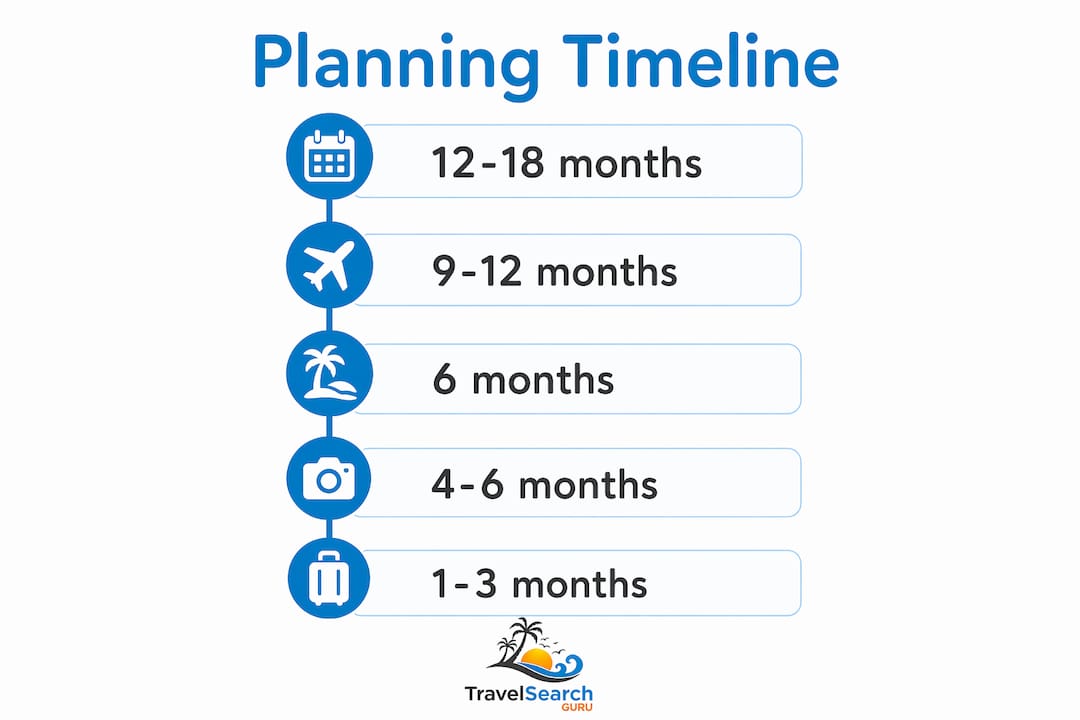
The table below shows the recommended planning timeline for a destination wedding in the Caribbean or Mexico.
| Planning milestone | Recommended timing |
|---|---|
| Book venue and set date | 12–18 months before wedding |
| Send save-the-dates with travel info | 9–12 months before wedding |
| Secure hotel room block | 9–12 months before wedding |
| Set guest RSVP deadline | 4–6 months before wedding |
| Confirm airport transfer schedule | 2–3 months before wedding |
| Send final travel guide to all guests | 4–6 weeks before wedding |
Couples planning at resorts like Excellence Playa Mujeres in Mexico or Secrets Cap Cana in the Dominican Republic should also check whether the resort offers a dedicated wedding coordinator. Resort coordinators handle on-property logistics, but they do not manage guest travel or airport transfers. You need both a resort coordinator and a travel coordinator to cover the full picture.
What are the risks of inadequate travel coordination for destination weddings?
Poor travel coordination does not just create inconvenience. It creates financial loss, damaged relationships, and a wedding day defined by stress instead of celebration.
- Higher no-show rates. Guests who receive unclear deadlines or confusing travel information simply do not book. By the time a couple realizes the problem, the room block has expired and flights have doubled in price.
- Airport transfer chaos. Without proactive transfer planning, guests arriving at Cancun or Punta Cana face an overwhelming number of unofficial transport options, many of which are overpriced or unreliable. Guests who get stranded or overcharged arrive at the resort in a bad mood that colors their entire experience.
- Vendor no-shows and unexpected fees. Vendors who travel internationally without confirmed logistics sometimes miss connections or arrive a day late. Without a coordinator managing those details, the couple absorbs the cost and the stress.
- Overpacked schedules. Common destination wedding problems include scheduling conflicts caused by underestimating guest travel timelines. When guests arrive exhausted from a long travel day and are immediately expected at a rehearsal dinner, the event suffers.
- Lost group discounts. Room blocks that expire before guests book result in guests paying full retail rates. The couple loses the negotiating leverage they had when the block was active.
- Budget overruns. Unmanaged vendor travel, last-minute transfer bookings, and unplanned guest assistance add up quickly. Couples without a coordination plan routinely spend more than couples who invested in professional help upfront.
“Many common destination wedding problems stem from limited travel guidance, unclear accommodation info, overly packed schedules, and underestimating guest travel timelines.” — Common Destination Wedding Mistakes
The financial risk alone justifies the investment in coordination. A couple who loses their room block discount across 20 rooms at a Riviera Maya resort can easily lose $3,000 to $5,000 in savings. That is more than the cost of professional coordination in most cases. The risks are not hypothetical. They happen at destination weddings every season, and they are almost entirely preventable.
Key Takeaways
Destination weddings require dedicated travel coordination because the gap between a smooth celebration and a logistical failure comes down to how well guest travel, transfers, and vendor logistics are managed from the start.
| Point | Details |
|---|---|
| Start planning early | Send save-the-dates 9–12 months out and set RSVP deadlines 4–6 months before the wedding. |
| Arrange airport transfers proactively | Transfers are rarely included at Caribbean and Mexico resorts; book them in advance for every guest. |
| Secure hotel room blocks immediately | Negotiate group rates right after booking the venue and set a clear guest booking deadline. |
| Use local vendors when possible | Local professionals eliminate $2,000–$4,000 in vendor travel costs and bring regional expertise. |
| Professional coordination pays for itself | Negotiated group rates and avoided last-minute costs typically exceed the coordinator’s fee. |
Our team’s take on travel coordination for destination weddings
We have worked with couples planning celebrations across the Caribbean and Mexico, from intimate ceremonies at boutique resorts in Tulum to large multi-day events at all-inclusive properties in Punta Cana. The pattern we see most often is this: couples who invest in travel coordination early have a fundamentally different experience than those who try to manage it themselves.
The couples who struggle are not disorganized. They are simply unaware of how different destination wedding logistics are from anything they have planned before. They underestimate how much coordination it takes to move 50 people from three different cities through an international airport and into a resort on the same day. They assume the resort handles transfers. It usually does not. They assume guests will figure out the booking process. Many will not without clear guidance.
What we find works in the Caribbean and Mexico specifically is leaning into the local knowledge that experienced coordinators bring. A coordinator who knows Cancun International Airport knows which transfer providers are reliable, which routes get congested on Saturdays, and which resorts have complicated check-in processes that need extra time. That regional knowledge is not something you can replicate with a Google search.
The couples who enjoy their wedding day the most are the ones who handed off the logistics to someone they trusted and then showed up present. That is the real value of professional travel coordination. It is not just about avoiding problems. It is about giving yourself permission to actually be there for the celebration you spent a year planning.
Our team at Travelsearch believes that destination expertise is not a luxury add-on. For a destination wedding, it is the foundation everything else is built on.
— Our Team at TravelSearch Guru
How TravelSearch Guru supports your destination wedding travel
TravelSearch Guru specializes in the travel logistics that make Caribbean and Mexico destination weddings work. Our team handles airport transfers for every guest arrival window, coordinates group bookings, and builds travel itineraries that account for every detail from landing to the last dance.

We bring real destination knowledge to resorts across Cancun, Punta Cana, Riviera Maya, and the Dominican Republic. Our team negotiates group rates, arranges reliable ground transportation, and serves as the single point of contact for guest travel questions. Couples who work with us spend their wedding week celebrating, not managing logistics. If you are ready to take the stress out of destination wedding travel, start with a travel assessment and let our team build a coordination plan around your specific venue and guest list.
FAQ
Why do destination weddings need a travel coordinator?
Destination weddings involve complex logistics including international flights, airport transfers, group hotel blocks, and vendor travel that local weddings do not require. A travel coordinator manages all of these moving parts so couples and guests can focus on the celebration.
When should guests receive save-the-dates for a destination wedding?
Send save-the-dates 9–12 months before the wedding date. Guests typically need a full year to request vacation time, budget for travel, and book flights at reasonable prices.
Are airport transfers included at Caribbean and Mexico resorts?
Airport transfers are rarely included automatically at international resorts in the Caribbean or Mexico. Without advance coordination, guests face unreliable transport options and unexpected costs on arrival.
How much does it cost to bring vendors to a destination wedding?
Bringing home-based vendors to a destination wedding typically adds $2,000–$4,000 in travel costs per vendor. Using local professionals eliminates those costs and often delivers better regional expertise.
What is the recommended RSVP deadline for a destination wedding?
Set your final RSVP deadline 4–6 months before the wedding date. This timeline gives guests enough runway to secure travel arrangements and gives you accurate numbers for room blocks and catering.