
A destination expert in family travel is a certified specialist who designs and manages tailored, harmonious trips by coordinating logistics, accommodations, and activities to meet the diverse needs of every family member. The role of destination expert in family trips goes far beyond booking hotels. These professionals apply structured planning methods, including rhythm management, anchor activities, and choice blocks, to prevent burnout and keep multi-generational groups happy. For families heading to Caribbean and Mexican resorts like Cancun, Riviera Maya, or Punta Cana, a destination specialist is the difference between a stressful trip and a genuinely memorable one.
What is the role of a destination expert in family trips?
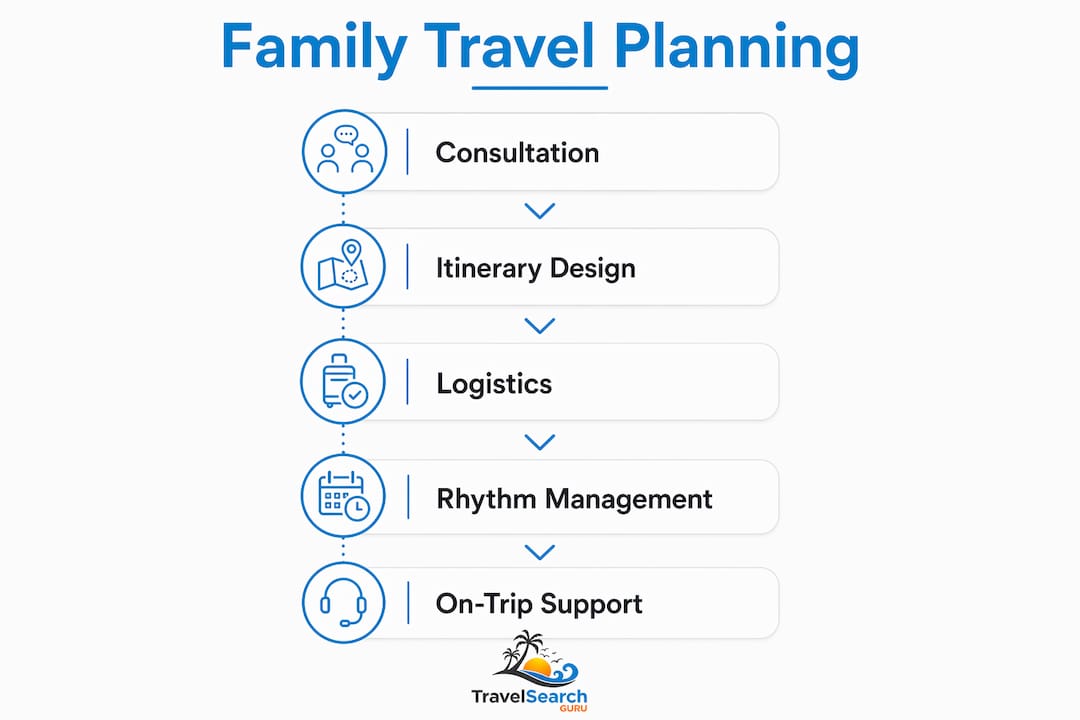
A destination expert, also called a Certified Family Travel Advisor, is trained to handle the full complexity of multi-generational travel. The industry term “destination specialist” reflects a professional who combines local knowledge with structured planning tools. This is not a standard travel agent who books flights and hotels. A destination expert designs the entire experience from the first consultation through the final transfer home.
The core tasks include itinerary customization, logistics management, and managing the social dynamics that come with traveling as a family. When grandparents, parents, teens, and toddlers all share the same trip, competing energy levels and preferences create real friction. Destination specialists solve this before it starts. They use child-development-aware planning to integrate age-appropriate activities and give children a voice in the trip, which keeps everyone engaged.

At Caribbean and Mexican resorts, the complexity multiplies. Families arriving from different cities need coordinated transfers. Resorts like Secrets Akumal in Riviera Maya or Hard Rock Hotel Cancun offer dozens of activity options, and choosing the right ones for a mixed-age group requires real expertise. Destination specialists know which excursions work for a 6-year-old and a 70-year-old simultaneously, and which ones will exhaust the group before lunch.
How do destination experts handle complex family travel logistics?
Complex logistical needs for multi-generational families include accessibility requirements, multi-city arrivals, and preventing overexertion through structured daily pacing. Logistics is where most DIY family trips fall apart. A destination expert handles every moving part so you never have to.
What a destination expert manages end to end
Here is what a full-service destination specialist coordinates for a Caribbean or Mexico family trip:
- Flights and connections: Coordinating arrivals from multiple cities so the full group lands within a manageable window
- Airport transfers: Arranging private or group resort transfers that accommodate car seats, strollers, and large luggage
- Accommodations: Selecting rooms with accessible features for elderly family members and connecting suites for families with young children
- Tour and activity bookings: Timing excursions around nap schedules, meal times, and energy peaks
- Dining reservations: Securing restaurant bookings at popular resorts before they fill up
- Ferry and local transport: Scheduling ferry routes and transfers for island excursions like Isla Mujeres near Cancun or Cozumel near Playa del Carmen
- Contingency planning: Building buffer time into every travel day so delays do not cascade into disasters
Routing plans that include ferry schedules and timed transfers reduce lost time and stress on travel days. That matters enormously when you have a toddler who missed a nap and a grandparent who needs to sit down.
Some families prefer a planning-only approach. In that model, the expert designs the full itinerary and logistics plan, and the family handles the actual bookings. This works well for experienced travelers who want professional guidance without full-service fees. Both models are valid. The right choice depends on your family’s comfort level and the complexity of your trip.
Pro Tip: Before your first consultation with a destination specialist, list every family member’s top three priorities and any hard limits, such as mobility restrictions or dietary needs. This single step cuts consultation time in half and produces a sharper first draft of your itinerary.
How do experts tailor itineraries for multi-generational families?
Multi-age family vacations often fail because of poorly managed daily rhythms rather than inadequate bookings. Forced marches through back-to-back activities cause burnout across every age group. Destination experts solve this with a specific design framework built around rhythm, anchor activities, and choice blocks.
Rhythm management means structuring each day around the natural energy cycles of the group. Toddlers need naps. Teens sleep late. Grandparents tire by mid-afternoon. A well-designed day at a Riviera Maya resort might start with a relaxed breakfast, move into one high-energy anchor activity, then open into free time before a group dinner. No one is dragged through six hours of activities without a break.
Anchor activities are the shared experiences that the whole family does together. A catamaran lunch off the coast of Cancun, a group snorkeling trip at Akumal Bay, or a guided cultural tour of Tulum ruins are examples. These create the shared memories that define the trip. The anchor activity plus choice blocks approach then opens the afternoon for independent choices. Grandparents visit the spa. Teens try paddleboarding. Parents relax at the pool. Everyone reunites for dinner with stories to share.
Choice blocks are the unscheduled windows that give each family member autonomy. This is not wasted time. It is the design feature that prevents the resentment that builds when everyone is forced into the same activity all day.
Here is the stepwise process destination experts use to build a family itinerary:
- Initial consultation: Gather ages, mobility needs, interests, budget, and travel dates for every family member
- Destination selection: Match the family profile to the right resort or region, such as Cancun for first-time Caribbean visitors or Riviera Maya for families wanting a mix of beach and culture
- Rhythm mapping: Design a daily structure that fits the energy levels of the youngest and oldest travelers
- Anchor activity selection: Choose two to three shared experiences per trip that work across all ages
- Choice block scheduling: Build open windows into each day for independent activities
- Booking coordination: Secure all reservations in the correct sequence, with timing that respects the rhythm plan
- Pre-trip briefing: Walk the family through the full plan so everyone knows what to expect
84% of parents report that children adapt better when involved in planning. Destination experts use this finding directly. They ask kids which activities they want and build those choices into the itinerary. That investment pays off in fewer complaints and more genuine engagement throughout the trip.
Pro Tip: Ask your destination specialist to include at least one activity chosen entirely by your youngest traveler. Children who feel heard behave better on vacation. This is not just good parenting. It is good trip design.
Destination expert vs. DIY family trip planning: which wins?
The biggest advantage of working with a destination expert is not access to better hotels. It is the professional management of family harmony through tailored rhythm and engagement strategies. DIY planning often fails to balance competing needs or manage transport complexities, resulting in stress and conflicts that overshadow the vacation itself.
Here is a direct comparison:
| Factor | DIY Planning | Destination Expert |
|---|---|---|
| Logistics coordination | Family manages all bookings independently | Expert handles flights, transfers, tours, and dining in sequence |
| Pacing and rhythm | Often unstructured, leading to burnout | Designed around each family member’s energy levels |
| Age-appropriate activities | Based on general research | Curated using child development knowledge and local expertise |
| Multi-city arrivals | Difficult to coordinate without local knowledge | Managed with timed transfers and contingency buffers |
| Financial coordination | Can create family tension over costs | Experts set up tiered billing strategies to reduce friction |
| Local knowledge | Limited to online reviews | Direct relationships with resorts, guides, and vendors |
DIY planning works for simple trips. A family of four flying to one resort for a week can manage the basics without professional help. The calculation changes for multi-generational groups, families with accessibility needs, or trips that combine multiple destinations. A Cancun trip that includes a day trip to Chichen Itza, a ferry to Isla Mujeres, and a cenote swim requires precise timing. One missed transfer ruins the day for everyone.
Expert family travel planners allow families to focus on enjoyment by handling all details, including trusted local guides and logistics. That is the core value proposition. You pay for the expertise so you can stop managing and start experiencing.
The family travel planning process at its best includes hotels, transportation, tours, dining reservations, and pacing designed for a stress-free experience. DIY planners rarely achieve all five simultaneously. Something always slips.
How should families work with destination experts effectively?
Working with a destination expert produces the best results when families come prepared and communicate clearly. The expert can only design what they know about. Vague requests produce generic itineraries.
Here is how to get the most from your collaboration:
- Document every family member’s needs before the first call. Include ages, mobility limitations, dietary restrictions, and any medical considerations. A grandparent who cannot walk long distances changes the entire excursion selection for a Riviera Maya trip.
- Share your budget range honestly. Destination experts can work across a wide range of budgets, but they need a real number to make smart recommendations. Vague answers lead to proposals that miss the mark.
- Identify your non-negotiables. Every family has one or two experiences they absolutely want. State these upfront. For some families, it is a private catamaran day. For others, it is a specific resort brand like Excellence Playa Mujeres or Barcelo Maya.
- Review the draft itinerary critically. Look for days that feel too packed or transitions that seem rushed. A good destination expert welcomes this feedback. The first draft is a starting point, not a final product.
- Ask about pre-booking excursions. Popular activities at Caribbean and Mexican resorts sell out weeks in advance. Pre-booking family excursions is one of the most practical steps you can take to protect your itinerary.
- Clarify financial arrangements early. Who pays for what in a multi-generational group is a common source of tension. Destination experts can structure billing so each family unit pays their share directly, removing the awkwardness entirely.
Travelsearch connects families with specialists who know Caribbean and Mexican resorts at a granular level. Our team understands which resorts at Punta Cana have the best kids’ clubs, which Cancun hotels offer accessible beach access, and which excursions genuinely work for a group spanning ages 4 to 74. That local knowledge is what separates a good trip from a great one. You can explore family-focused tours and activities directly on the platform to see what expert curation looks like in practice.
Key takeaways
Destination experts deliver family vacation success through logistics mastery, rhythm-based itinerary design, and child-development-aware planning, not just better hotel bookings.
| Point | Details |
|---|---|
| Rhythm management is the core skill | Experts structure days around energy levels to prevent burnout across all age groups. |
| Logistics coordination is non-negotiable | Multi-city arrivals, transfers, and ferry schedules require professional sequencing for Caribbean and Mexico trips. |
| Anchor activities build shared memories | One or two group experiences per day create the moments families remember most. |
| DIY planning struggles with complexity | Multi-generational trips with accessibility needs or multiple destinations consistently exceed DIY capacity. |
| Preparation improves expert outcomes | Families who document needs and budgets before consultation receive sharper, more personalized itineraries. |
Why expert planning changes everything about family travel
Our team has worked with hundreds of families traveling to Cancun, Riviera Maya, Punta Cana, and Los Cabos. The pattern we see repeatedly is this: families who plan their own complex trips arrive stressed and spend the first two days recovering from the journey. Families who work with a destination specialist arrive ready to enjoy the experience from day one.
The conventional wisdom says that travel planning is something any organized person can handle. We disagree with that framing. Organizing a trip for two adults is a logistics task. Organizing a trip for twelve people spanning four generations, three cities of origin, two mobility limitations, and five different ideas of a perfect vacation is a professional discipline.
What surprises most families is how much of the value comes from the soft skills, not the bookings. Managing the conversation about who pays for what. Knowing that a 14-hour activity day will destroy the group’s energy for the rest of the trip. Understanding that a teenager who gets to choose one activity will be a better travel companion for the entire week. These are not things you learn from a travel blog. They come from experience and training.
The Caribbean and Mexican resort market has also grown significantly more complex. Riviera Maya alone now has dozens of major resort properties, each with different strengths for different family profiles. Choosing between an all-inclusive at Akumal versus a boutique property near Tulum versus a mega-resort in Playa del Carmen requires real knowledge. The wrong choice is not just a minor inconvenience. It shapes the entire trip.
Our honest recommendation: if your family trip involves more than six people, multiple generations, or any special needs, work with a destination specialist. The cost is almost always recovered in avoided mistakes, better rates through professional relationships, and the simple value of not spending your vacation managing logistics.
— Our Team at TravelSearch Guru
Plan your family trip with Travelsearch guru
Travelsearch specializes in family vacation planning for Caribbean and Mexican destinations, including Cancun, Riviera Maya, Punta Cana, and Los Cabos. Our team handles every detail, from airport transfers and resort selection to curated excursions and dining reservations, so your family arrives ready to enjoy every moment.
Start with our travel assessment to identify your family’s travel style, priorities, and ideal destination. The assessment takes minutes and gives our specialists the foundation they need to build a trip your family will talk about for years. Whether you are planning a first Caribbean vacation or a milestone multi-generational reunion, Travelsearch has the local expertise and professional network to make it exceptional.
FAQ
What does a destination expert do for family trips?
A destination expert designs and manages the full travel experience, including itinerary customization, logistics coordination, and activity curation tailored to every family member’s age and needs. Their role goes beyond bookings to include rhythm management and family harmony strategies.
How is a destination specialist different from a travel agent?
A destination specialist holds specialized training in multi-generational travel, child development, and logistics management, while a standard travel agent primarily handles bookings. Destination specialists design structured daily rhythms and curate age-appropriate experiences rather than simply reserving flights and hotels.
Why do multi-generational family trips need professional planning?
Multi-generational trips involve competing energy levels, accessibility needs, and multi-city logistics that consistently overwhelm DIY planners. Expert coordination prevents the burnout and conflicts that arise from unstructured pacing and poor transport sequencing.
What are anchor activities in family trip planning?
Anchor activities are shared group experiences, such as a catamaran excursion or a cultural tour, that the whole family does together. They are paired with choice blocks, which are open windows for independent activities, to balance group bonding with personal freedom.
How do i choose the right destination expert for my family?
Look for a Certified Family Travel Advisor with direct experience in your target destination, such as Caribbean or Mexican resorts. Ask specifically about their approach to rhythm management, multi-generational logistics, and how they handle families with accessibility needs or mixed age groups.