
Corporate travel management, known formally as travel and expense (T&E) governance, is one of the most cost-heavy and operationally fragmented functions a company runs. When travel logistics go unmanaged, you pay for it twice: once in inflated costs and again in lost productivity. The good news is that the most effective ways to streamline business travel logistics are now well-documented, and they all point in the same direction. Enforce policy earlier, automate the manual work, connect your data, and build disruption response into your process from day one.
Table of Contents
- Key takeaways
- Ways to streamline business travel logistics through smarter policy enforcement
- Automating expense reporting and reimbursement
- AI orchestration for unified booking visibility
- Handling travel disruptions without losing the day
- Optimizing booking timelines and approval workflows
- My honest take on what actually moves the needle
- How TravelSearch Guru can support your travel program
- FAQ
Key takeaways
| Point | Details |
|---|---|
| Enforce policy at booking | Embedding travel rules at the booking stage prevents non-compliant choices before they happen. |
| Automate expense reporting | OCR and AI tools compress reimbursement cycles from weeks to just days. |
| Unify booking data with AI | Orchestration layers catch off-platform bookings and close visibility gaps across channels. |
| Build disruption readiness | Fast rebooking workflows and proactive communication protect traveler productivity. |
| Use advance booking windows | Targeting 14 days domestic and 21+ days international reduces last-minute costs and delays. |
Ways to streamline business travel logistics through smarter policy enforcement
Most corporate travel programs have a policy document. Far fewer have a policy that actually works at the moment it matters most: when a traveler is choosing a flight or hotel. The biggest cost-control leverage comes from encoding travel policy logic inside the booking experience rather than managing it as a separate PDF or post-trip audit.
Here is what a well-enforced booking policy looks like in practice:
- Spending limits by category. Set hard caps on airfare by cabin class and route, hotel rates by city tier, and daily meal allowances. These should be numbers, not ranges.
- Preferred supplier filtering. Configure your booking tool to surface only approved airlines, hotel chains, and car rental vendors by default. Travelers should not have to hunt for compliant options.
- Advance booking requirements. Define minimum lead times for domestic and international trips. Booking within the required window should trigger an automatic flag, not a retroactive conversation.
- Threshold-based approval routing. Trips under a defined spend threshold get auto-approved. Trips above it route to a manager or finance contact with a defined response deadline.
- Exception handling with written justification. Out-of-policy bookings should require a written reason before confirmation, not after. Proactive enforcement at booking is far more effective than post-trip auditing.
The critical mistake most programs make is writing rules that are too vague. “Book economy when reasonable” is not a policy. “Book economy for all domestic flights under four hours” is. Clear, specific policies reduce rebooking and ad-hoc approvals by removing ambiguity from every decision.
Pro Tip: Overly restrictive policies backfire. If travelers cannot find a compliant option easily, they book outside the system entirely. Build in a small buffer of flexibility, such as one upgrade option per quarter, to keep travelers inside your approved channels.
Automating expense reporting and reimbursement
Manual expense reporting is one of the biggest time sinks in corporate travel. A traveler collects paper receipts across a five-day trip, submits a spreadsheet two weeks later, and waits another two weeks for reimbursement. That 28-day cycle is not just slow. It drives out-of-policy behavior because employees stop caring about compliance when the process feels punishing.
Expense automation compresses that cycle from 14 to 28 days down to 3 to 7 days using three core tools: optical character recognition (OCR) to capture receipts instantly, AI policy checks to flag violations inline, and threshold-based routing to send approvals to the right person automatically.
The approver experience improves just as dramatically. Manager review time drops from 5 to 8 minutes per receipt to roughly 90 seconds when AI generates a policy brief alongside each submission. Low-value expenses get auto-approved entirely, which prevents inbox overload and keeps the process moving.
Key capabilities to look for in an automation platform:
- Mobile receipt capture with OCR that categorizes the expense immediately upon photo upload
- Inline policy enforcement that flags violations before submission, not after
- Automatic routing based on spend category, amount, and traveler role
- Real-time dashboards showing spend by department, trip, and category for finance teams
- Integration with corporate cards and payroll to close the loop between spending and reimbursement
Pro Tip: Choose tools that connect directly to your corporate card program. When card transactions feed automatically into the expense system, travelers spend less time on data entry and finance gets cleaner data with fewer manual reconciliations.
Finance teams consistently underestimate the impact of shortening reimbursement cycles. When employees know they will be paid back within a week, they stop using personal cards and booking outside the system. That behavior shift alone improves compliance more than most policy updates.
AI orchestration for unified booking visibility
Here is a number that should concern every travel manager: only 18% of business travelers book all travel through the company’s designated platform. The rest use consumer sites, direct airline apps, or personal cards, creating what the industry calls “leakage.” Finance cannot see it. Policy cannot touch it. And it adds up fast.
AI orchestration layers solve this by sitting below the booking interface and connecting data from every channel and payment rail into a single governance view. The comparison below shows the difference between a fragmented and an orchestrated approach:
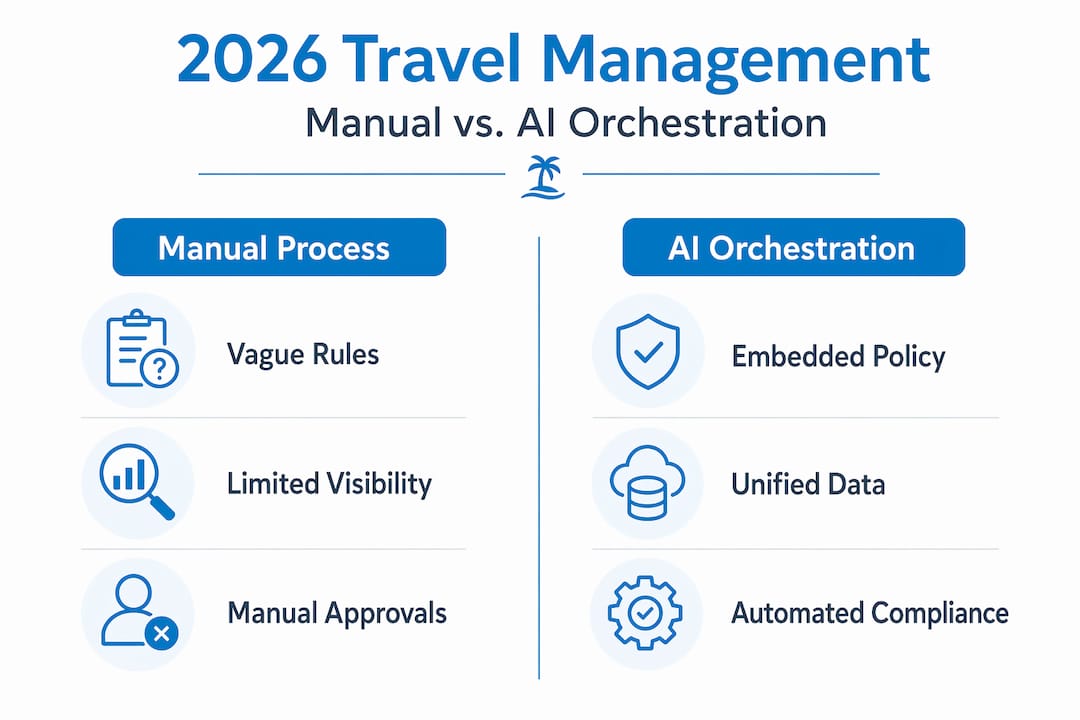
| Dimension | Fragmented approach | Orchestrated approach |
|---|---|---|
| Booking visibility | Only approved platform bookings visible | All channels captured and reconciled |
| Policy enforcement | Applied at booking tool only | Enforced at transaction level regardless of source |
| Expense reconciliation | Manual matching of receipts to trips | Automated matching across cards and channels |
| Anomaly detection | Reactive, post-trip review | Real-time flagging of unusual spend patterns |
| Currency and entity handling | Manual conversion and allocation | Automated across entities and currencies |
Governance models that assume a human manually initiates every booking fall short in practice. Policy enforcement needs to operate below the transaction layer to catch manual bookings, automated agent purchases, and direct supplier payments consistently.
For global companies, this matters even more. Managing multiple legal entities, currencies, and approval hierarchies manually is where travel programs break down. Orchestration layers handle partial personal payment reconciliation and flag anomalies across all of these scenarios without requiring a finance analyst to chase down every exception.
Pro Tip: The goal of an orchestration layer is not to restrict travelers more. It is to make compliance invisible. When the system handles reconciliation automatically, travelers stop feeling policed and start booking through approved channels because it is simply easier.
Handling travel disruptions without losing the day
A flight delay should not cost an executive four hours of productivity. But without a real disruption management process, that is exactly what happens. The traveler calls a general support line, waits on hold, and eventually gets rebooked on the last available seat. By then, the meeting is missed and the day is gone.
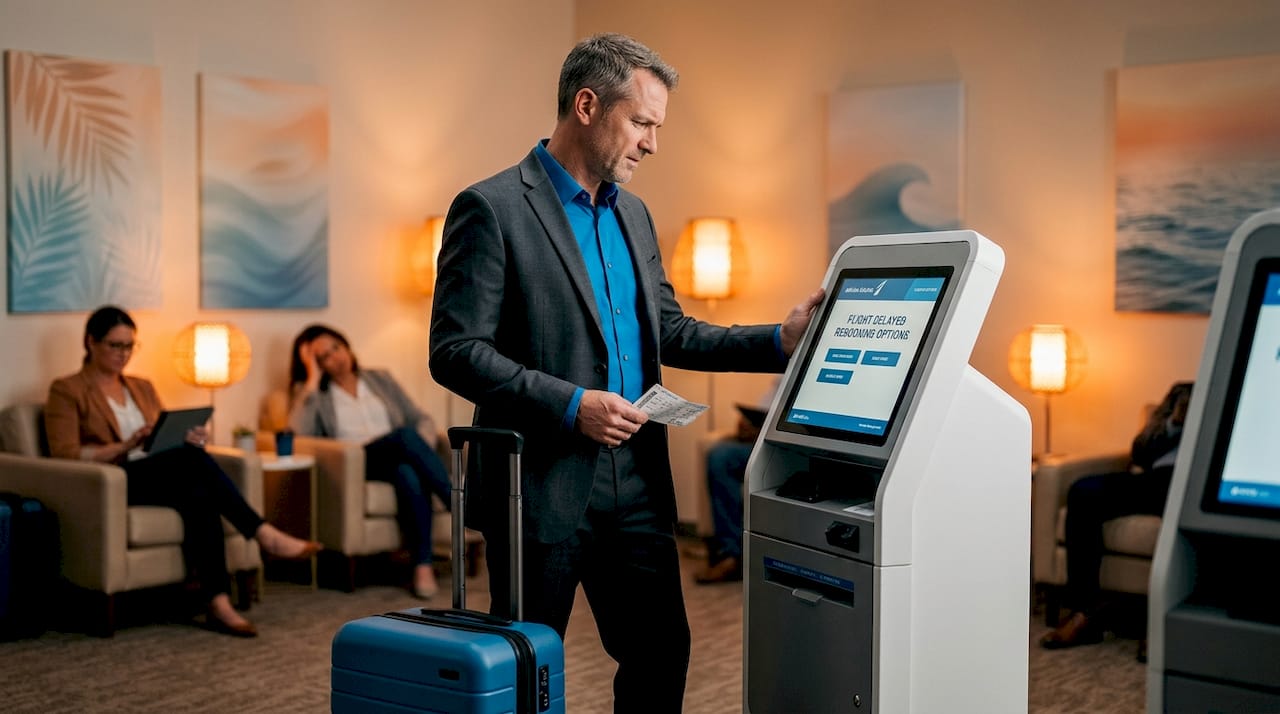
Disruption readiness treats rebooking and communication as infrastructure, not as a reactive service. Without fast access to itinerary context and the ability to rebook at scale in minutes, response times degrade significantly when disruptions hit multiple travelers at once.
Programs targeting under 90-second response times dramatically reduce traveler downtime compared to the industry average of 30 minutes on hold. That gap is not just about speed. It is about having the itinerary data, the rebooking authority, and the supplier relationships ready before the disruption happens.
Practical steps to build disruption readiness into your program:
- Pre-load traveler profiles with seat preferences, loyalty numbers, and emergency contacts so rebooking agents do not start from scratch
- Enable push notifications through your travel app for gate changes, delays, and rebooking confirmations
- Set up communication workflows that notify the traveler, their manager, and the meeting host simultaneously when a disruption occurs
- Define rebooking authority levels so agents can act without waiting for approval on standard alternatives
- Use AI itinerary tools that update schedules in seconds rather than requiring manual revision across multiple legs
The travelers who feel most supported during disruptions are the ones who receive a proactive notification and a new itinerary before they even reach the gate agent. That experience requires preparation, not luck.
Optimizing booking timelines and approval workflows
Last-minute bookings are one of the most preventable sources of excess travel spend. A domestic flight booked three days out can cost two to three times more than the same seat booked two weeks ahead. The solution is not just encouraging early booking. It is building the timeline into your approval workflow so that late requests trigger a different process.
Recommended advance booking windows by trip type:
| Trip type | Target booking window | Notes |
|---|---|---|
| Domestic (under 4 hours) | 14 days minimum | Later bookings require manager justification |
| International (long-haul) | 21+ days minimum | Complex itineraries need more lead time |
| Multi-city or conference trips | 30+ days minimum | Group rate negotiations require early commitment |
Leading programs also target a 7-day reimbursement cycle, which is far shorter than the legacy 21-day standard. When travelers know the approval and reimbursement process is fast, they plan ahead instead of waiting until the last minute.
To make this work operationally, your approval workflow needs:
- Defined response SLAs for each approver tier (24 hours for standard requests, 4 hours for urgent travel)
- Automatic escalation when an approver does not respond within the SLA window
- Clear rules for what qualifies as urgent travel versus avoidable last-minute booking
- Coordination between finance, HR, and travel teams on who owns each approval step
Vague approval chains are where most programs lose time. When a traveler does not know who approves their trip or how long it takes, they either book without approval or delay the whole process. Precision in the workflow design pays off in fewer rebookings and lower average ticket costs.
My honest take on what actually moves the needle
I have reviewed a lot of corporate travel programs, and the pattern I keep seeing is the same. Companies invest in a booking tool, write a policy document, and assume the problem is solved. Then they wonder why spend keeps climbing and compliance stays low.
What I have found actually works is embedding the rules directly into the booking experience. When a traveler cannot see a non-compliant option, they do not book it. That is not restriction. That is good design. The policy enforcement insight that resonates most with me is this: the best policy is one travelers never have to think about because the system handles it for them.
The other thing I have learned is that disruption management is not a nice-to-have. It is core logistics infrastructure. Every program I have seen that treats disruption response as an afterthought ends up with frustrated travelers who start booking outside the system entirely. Once that happens, you lose visibility, and visibility is everything.
What I would tell any travel manager starting fresh: fix the booking experience first, automate the expense process second, and build your disruption response before you need it. Theory and practice align closely here, which is rare in operations. The programs that follow this sequence consistently outperform the ones that do not.
— Alexander
How TravelSearch Guru can support your travel program
Managing corporate travel logistics across multiple destinations, booking channels, and traveler preferences is a real operational challenge. TravelSearch Guru brings together curated transfers, expert logistics support, and destination-specific services to help travel managers deliver a better experience without adding complexity to their workload.

Whether you need reliable airport-to-hotel transfers for executive travelers or want to add curated experiences to a business trip itinerary, TravelSearch Guru handles the details. The platform’s real-world travel expertise and hands-on support mean your travelers arrive prepared, on time, and well-supported when disruptions happen. Start with a travel assessment to identify where your current logistics can be tightened and where TravelSearch Guru can fill the gaps.
FAQ
What is the most effective way to enforce corporate travel policy?
Embedding policy rules directly into the booking tool is the most effective approach. Proactive enforcement at booking prevents non-compliant choices before they happen, unlike post-trip auditing which catches problems too late.
How much can expense automation reduce reimbursement time?
Expense automation compresses reimbursement cycles from 14 to 28 days down to 3 to 7 days using OCR, inline policy checks, and threshold-based approval routing.
What is travel “leakage” and why does it matter?
Travel leakage refers to bookings made outside the company’s approved platform. Only 18% of business travelers book exclusively through designated tools, meaning most spend is invisible to finance and outside policy controls.
What advance booking windows should corporate programs target?
Most programs target 14 days for domestic trips and 21 or more days for international travel. These windows reduce last-minute fare premiums and give approval workflows enough time to function without delays.
How should companies handle travel disruptions efficiently?
Build disruption response as a standing process, not a reactive one. Programs with sub-90-second response times and pre-loaded traveler profiles dramatically reduce downtime compared to standard support channels.