
For most leisure trips to the Dominican Republic, the right move is simple: buy a Claro-routed travel eSIM, install it before you board, and activate it the moment you land. For a 3–7 day resort stay, Airalo offers the most familiar app experience, Holafly suits travelers who want unlimited day passes without counting gigabytes, and Nomad wins on per-GB value for longer or budget-conscious trips. All three work on the Claro network, which covers the Punta Cana and Bávaro resort corridors best.
Your phone must be carrier-unlocked and eSIM-capable (iPhone XS or later, Pixel 3a or later, and most flagship Android phones from 2020 onward). Prices for a Dominican Republic eSIM typically run $5–$12 for a 3GB plan and $10–$20 for 10GB, depending on the provider and validity window. Industry analysis finds eSIM is the recommended choice for about 90% of leisure travelers, with device compatibility and carrier-unlock status as the main adoption barriers.
Pro Tip: Price examples above are snapshots. Check each provider’s app or website for current rates before purchasing, as eSIM plan pricing updates frequently.
Table of Contents
- 1. Which eSIM providers work best in the Dominican Republic?
- 2. How to choose the right Dominican Republic eSIM for your trip
- 3. How much data do you actually need in the Dominican Republic?
- 4. eSIM vs. local physical SIM vs. roaming: which makes sense for your trip?
- 5. How to buy and activate your Dominican Republic eSIM before you fly
- Sources
1. Which eSIM providers work best in the Dominican Republic?
Each of the six providers below offers a Dominican Republic plan. Their differences come down to pricing structure, hotspot policy, and how much hand-holding the app gives you during setup.
Airalo is the go-to for travelers who have used an eSIM before. The app is clean, the purchase flow takes under three minutes, and plans start around $5–$6 for 1GB with 7-day validity. Hotspot tethering is allowed on most DR plans, and top-ups are available in-app. Refunds are only possible before activation. Claro routing covers the resort corridors best, and Airalo routes over Claro for Dominican Republic plans.
Holafly takes a different approach entirely. Instead of selling gigabytes, it sells days of unlimited data. A 5-day unlimited pass runs approximately $19, which is competitive if you stream video or use maps heavily. The catch: hotspot tethering is not included, so you cannot share your connection with a laptop or tablet. No top-up option exists either. For a solo traveler at an all-inclusive in Punta Cana who just wants to post photos and use WhatsApp, it works well. For anyone who needs to tether, look elsewhere.
Nomad is the clearest choice for budget travelers on trips of two weeks or more. A 5GB plan with 30-day validity typically runs around $8, and a 10GB plan sits around $13. Hotspot is allowed, top-ups are available, and the app is straightforward. Per-gigabyte cost on the larger plans beats most competitors.
GigSky fills a specific gap: single-day unlimited passes for cruise passengers or travelers with a one-night stopover. If you dock in La Romana or Puerto Plata for eight hours and need reliable data without committing to a week-long plan, GigSky’s day-pass structure is genuinely useful. Multi-network routing (Claro and Altice) gives it slightly better urban coverage than single-network options.
Ubigi is built for travelers who visit multiple countries on one trip. Its app manages plans across destinations, and the Dominican Republic plan runs on Claro. A 3GB plan costs around $9. If your itinerary includes Mexico or another Caribbean island alongside the DR, Ubigi’s multi-destination management is worth the slight price premium over Nomad.
Saily offers a slightly different plan mix with regional focus. Pricing is mid-tier (around $7 for 3GB), hotspot is allowed, and the app includes some features that frequent travelers appreciate. It is a solid backup option if your preferred provider is sold out of a specific plan size, though its brand recognition and review volume are smaller than Airalo or Holafly.
- Activation method: All six providers support QR code installation. Airalo, Ubigi, and Saily also offer direct app-based (automatic) install on compatible devices.
- Coverage note: Claro is the dominant network for resort corridors including Punta Cana, Bávaro, and La Romana. GigSky’s multi-network routing adds Altice, which improves coverage in Santo Domingo and Santiago.
- Hotspot restriction: Holafly’s no-tethering policy is the most significant limitation in this group. Confirm hotspot rules before buying if you plan to share data with another device.
2. How to choose the right Dominican Republic eSIM for your trip
Before you open any provider’s app, run through this checklist.
Pre-purchase checklist:
- Your phone is carrier-unlocked (contact your home carrier if unsure)
- Your device supports eSIM (check Apple or Google support pages for your exact model)
- You know your trip length and have a rough data estimate
- You know whether you need hotspot/tethering for a laptop or second device
- You have confirmed whether you need a local Dominican Republic number (eSIMs provide data only; for calls, you will need a VoIP app like WhatsApp or a separate local SIM)
Questions to ask on the provider’s plan page:
- Does the plan explicitly state the network partner (Claro, Altice, or both)?
- When does validity start: on purchase, on installation, or on first network connection?
- Is top-up available, and how quickly does it activate?
- What is the refund window, and does it require contacting support or is it self-serve?
- Is hotspot/tethering explicitly permitted, or is it silent on the issue (treat silence as a no)?
Red flags to avoid:
- No network-partner disclosure on the plan page
- Validity that starts on purchase rather than first use (you lose days before landing)
- No stated refund or exchange policy
- Recent app-store reviews mentioning activation delays of more than 30 minutes
- Plans that advertise “unlimited” without clarifying whether hotspot is included
Decision flow by trip profile:
- One-day stopover or cruise port call → GigSky single-day unlimited
- 2–4 day short stay, no tethering needed → Holafly unlimited day pass
- 3–7 day resort stay, moderate use → Airalo 3–5GB, 7-day plan
- 7–14 day trip, mixed resort and city → Nomad 5–10GB, 30-day plan
- Multi-destination trip (DR + Mexico or another island) → Ubigi multi-destination plan
- 14–30 day stay on a budget → Nomad 10GB, 30-day plan
For geography: if you are staying at a resort in Punta Cana, Bávaro, or La Romana, any Claro-routed plan works well. If your itinerary includes Santo Domingo or Santiago, a provider with multi-network routing (Claro + Altice) gives you better urban coverage.
3. How much data do you actually need in the Dominican Republic?
Practical data-usage guidance recommends 1–3GB for light users, 3–5GB for regular travelers, and 10GB+ for heavy users. Here is what those numbers look like in practice at a Punta Cana or Bávaro resort.
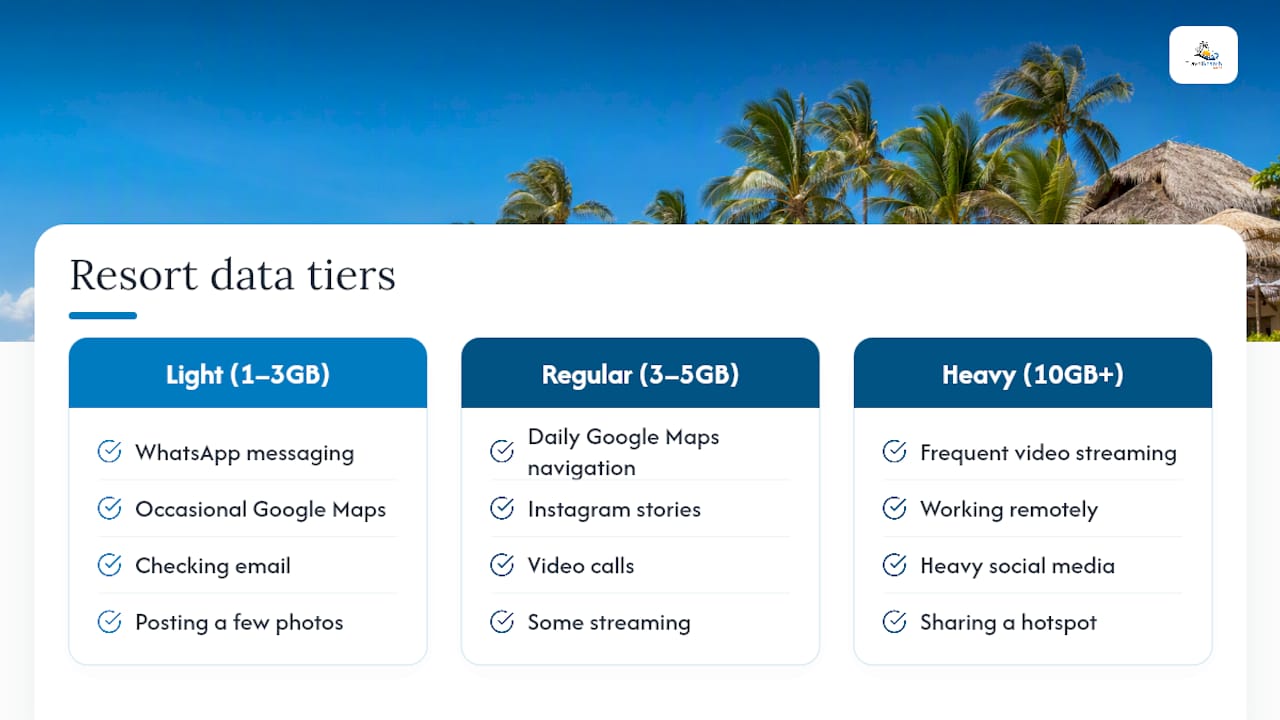
Light use (1–3GB): WhatsApp messaging, occasional Google Maps, checking email, and posting a few photos. This covers most guests who spend the majority of their time at the resort and use the hotel Wi-Fi for anything data-heavy. Guests at properties like Secrets Royal Beach Punta Cana or the Riu Republica typically fall here if they stay on-property.
Regular use (3–5GB): Daily Google Maps navigation, Instagram stories, video calls, and some streaming. This fits travelers who take day excursions (Saona Island, Altos de Chavón, whale-watching in Samaná) where resort Wi-Fi is unavailable for hours at a time.
Heavy use (10GB+): Frequent video streaming, working remotely, heavy social media, or sharing a hotspot with a travel partner. If you are tethering a laptop or tablet, add at least 3–5GB to whatever you would use on your phone alone.
Data tip: A one-hour WhatsApp video call uses roughly 200–300MB. An hour of Google Maps navigation uses about 50–100MB. Streaming one hour of video on a mobile connection uses 500MB–1.5GB depending on quality settings.
Offline maps save real data. Download your destination area in Google Maps or Maps.me before flying. A full offline map of the Punta Cana region is under 100MB and eliminates navigation data use entirely during excursions.
Resort Wi-Fi is useful for heavy tasks (video downloads, large uploads) but can be unreliable away from the main lobby. WhatsApp is the dominant local messaging tool for drivers, excursion operators, and hotel staff, so keeping at least a small data plan active matters even at all-inclusive properties.
4. eSIM vs. local physical SIM vs. roaming: which makes sense for your trip?
For the vast majority of short-to-medium leisure trips to the Dominican Republic, eSIM is the better choice. Industry analysis confirms eSIM is recommended for about 90% of leisure travelers, with the main barriers being device compatibility and carrier-unlock status.
eSIM advantages:
- Buy and install before you leave home, no airport kiosk queue
- No physical SIM swap required; keep your home number active on the same device
- Instant activation on arrival; no passport registration needed
- Competitive pricing for short-stay data plans
eSIM limitations:
- Requires a carrier-unlocked, eSIM-capable device
- Data only (no local Dominican Republic number)
- Phones purchased in China or India may have eSIM software disabled at the hardware level; verify your exact model and regional variant before purchasing
Physical local SIM advantages:
- Available at Punta Cana International Airport (PUJ) kiosks from Claro, Altice, and Viva
- Local SIM cards cost RD$200–300 for the card itself, with data packages running RD$500–1,000 (approximately US$8–17) for 10–20GB with roughly 30-day validity
- Useful for long stays (30+ days) or travelers with locked or older phones
- Passport registration is commonly required at the point of sale
Physical SIM limitations:
- Requires swapping out your home SIM (risk of losing it)
- Airport kiosk queues on busy arrival days
- Passport required; adds friction on a tired travel day
International roaming:
- Convenient but expensive. Most North American carriers charge $10–$15 per day for international day passes. For a 7-day trip, that is $70–$105 versus $8–$20 for an eSIM plan.
Local network coverage:
Claro has the strongest signal in the resort corridors: Punta Cana, Bávaro, La Romana, and Puerto Plata. Altice performs better in some urban cores, particularly Santo Domingo and Santiago. Viva operates a smaller network and is generally the third choice for tourists. For most resort-based itineraries, any Claro-routed eSIM covers your needs.
5. How to buy and activate your Dominican Republic eSIM before you fly
Install at least 48 hours before departure while on stable Wi-Fi, then activate on arrival by connecting to a local network. Validity on most plans starts on first local network connection, not on installation, so installing early does not waste a single day of your plan.
Step-by-step:
- Check device unlock and eSIM support. Go to Settings → General → About (iPhone) or Settings → Network (Android) and confirm eSIM is listed. Contact your carrier if the phone is still locked.
- Buy your plan. Open the provider’s app (Airalo, Nomad, Ubigi, etc.) or visit their website. Select “Dominican Republic,” choose your plan size and validity, and complete payment.
- Install the eSIM profile. Most providers send a QR code by email and display it in-app. Go to Settings → Cellular → Add eSIM (iPhone) or Settings → Network → SIM Manager (Android), then scan the QR code. Some providers (Airalo, Ubigi) support direct app-based install without a QR code.
- Label the plan. Name it something clear like “DR Travel” so you can identify it in settings quickly on arrival.
- Set data preferences. In your cellular settings, designate the travel eSIM as the mobile data line. Leave the home SIM active for calls and texts, but turn off data roaming on it to avoid background charges.
- Save the QR code offline. Screenshot it and save it to your camera roll. Keep an offline copy of your QR/activation details in case you need to reinstall without Wi-Fi access.
- Activate on arrival. Switch mobile data to your travel eSIM as soon as you land. The plan clock starts here, not when you installed it.
Pro Tip: If you are transiting through another airport before the Dominican Republic, do not switch to the travel eSIM until you land in Punta Cana or Santo Domingo. Connecting to a network in a transit country may start your plan validity early on some providers.
Common troubleshooting issues:
- QR code won’t scan: Increase screen brightness on the device displaying the QR, or use the manual activation code the provider includes in the same email.
- Activation stalls at “Activating…”: Move to a stronger Wi-Fi signal and wait up to 10 minutes. If it still fails, delete the eSIM profile and reinstall.
- Carrier lock error: Your phone is still locked to your home carrier. Contact them before departure; unlock requests can take 24–72 hours.
- Wrong line selected for data: Go to Settings → Cellular → Cellular Data and confirm the travel eSIM is selected, not your home SIM.
- Hotspot not working: Some plans require hotspot to be enabled in the provider’s app settings, not just in your phone’s settings. Check the provider’s support page.
- Unexpected roaming charges: Your home SIM’s data roaming is still on. Disable it in Settings → Cellular → [Home SIM name] → Data Roaming.
How we evaluated these providers
Our picks are based on a combination of live pricing checks across each provider’s app and website, network routing disclosures (specifically whether Claro, Altice, or both are listed), published coverage maps, and recent user feedback including Trustpilot reviews.
Trust signals we looked for in each provider:
- Explicit network partner listed on the plan page (not just “local networks”)
- Validity start rule stated clearly (purchase vs. first use)
- Hotspot/tethering policy stated, not implied
- Top-up availability confirmed in-app
- Refund or exchange policy with a stated window
- Recent Trustpilot or app-store reviews mentioning Dominican Republic activation
What we did not include: We did not test activation speeds personally on Dominican Republic networks. Price examples are snapshots from plan pages and may have changed. We excluded providers with no stated network partner for the Dominican Republic, and we did not include providers whose plans showed no recent user reviews for this specific destination.
Pricing freshness note: Price checks for this guide were conducted in early 2026. eSIM plan pricing changes frequently; verify current rates on each provider’s platform before purchasing.
Our team’s take: resort connectivity tips from TravelSearch Guru
If you are flying into Punta Cana International Airport and heading straight to a resort in Bávaro or La Romana, install a Claro-routed eSIM before you board. That single step eliminates the most stressful part of arrival day.
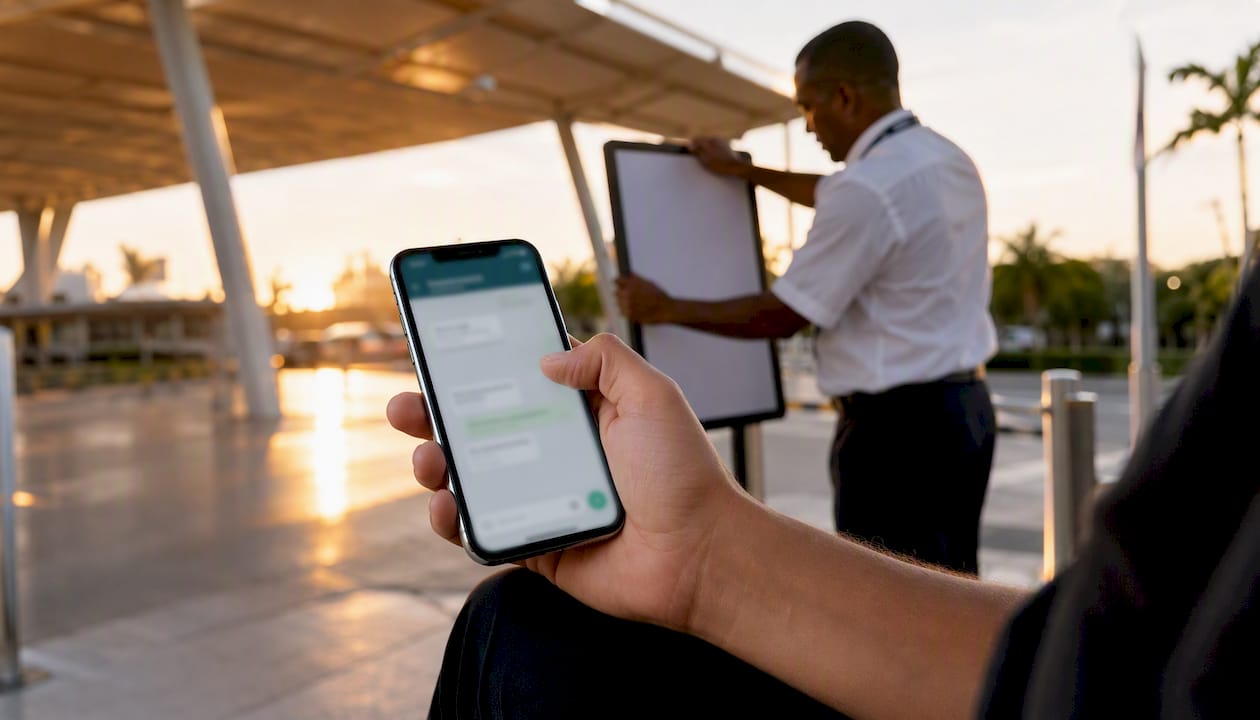
We have seen it play out the same way at properties like Excellence Punta Cana, Secrets Royal Beach, and the Hilton La Romana: guests who land with an active eSIM walk through customs, spot their driver holding a sign, confirm the pickup via WhatsApp in 30 seconds, and are in the transfer vehicle before the luggage carousel clears. Guests who land without data spend 15 minutes hunting for airport Wi-Fi or queuing at a SIM kiosk. WhatsApp is the dominant messaging channel for local operators and excursion drivers, so having data the moment you land is not a luxury; it is how the logistics actually work.
For excursions, the same principle applies. Whether you are booking a last-minute catamaran trip from Punta Cana or confirming a pickup time for a private tour to Altos de Chavón near La Romana, your driver or operator will reach you on WhatsApp. A 3–5GB plan handles a full week of this kind of coordination without coming close to the limit.
One practical tip for resort guests: use hotel Wi-Fi for anything data-heavy (video calls home, downloading offline maps, streaming at night) and save your mobile data for the moments when Wi-Fi is not available, which is every excursion, every transfer, and every beach bar visit. That strategy stretches a 3GB plan across a 7-day trip with data to spare.
TravelSearch Guru helps you plan what comes after the eSIM
TravelSearch Guru does not sell eSIMs. What we do is handle the part that comes right after you land with a working connection: getting you from the airport to your resort without stress, and filling your days with excursions worth the trip.
Once your eSIM is active and you step off the plane at Punta Cana International, the next thing you need is a driver who is already there. Our Dominican Republic airport transfers are pre-booked, meet-and-greet style, and confirmed via WhatsApp, so your first message on that new eSIM connection can be “I’m at baggage claim” rather than “where do I find a taxi?”
Beyond the transfer, our team curates excursions across Punta Cana, La Romana, and the wider Caribbean so you are not piecing together day trips from a hotel lobby brochure. Every booking is coordinated with operators who communicate on WhatsApp, which means your eSIM and your itinerary work together from the moment you land.

Book your airport transfer before you fly, and arrive knowing the first hour of your trip is already handled.
Key Takeaways
A Claro-routed travel eSIM installed 48 hours before departure is the fastest, most reliable way to stay connected throughout a Dominican Republic resort trip, from airport arrival to final excursion.
| Point | Details |
|---|---|
| Install before departure | Set up your eSIM at least 48 hours before flying; validity starts on first local network connection, not installation. |
| Match plan size to usage | Light resort stays need 1–3GB; regular travelers with excursions need 3–5GB; heavy users or tethering needs 10GB+. |
| Claro for resorts, Altice for cities | Claro covers Punta Cana, Bávaro, and La Romana best; Altice adds coverage in Santo Domingo and Santiago. |
| Confirm hotspot policy first | Holafly does not allow tethering; Airalo, Nomad, Ubigi, and Saily do on most plans. Check before buying. |
| TravelSearch Guru handles the rest | Pre-book airport transfers and excursions through TravelSearch Guru; operators confirm via WhatsApp once your eSIM is active. |
Sources
Before you buy, verify current pricing and coverage directly from the primary sources. Plan prices change, and a 10-minute check saves real money.