
Travel coordination for corporate trips is the organized management of all travel logistics — flights, hotels, ground transportation, and real-time disruptions — within company policy to ensure smooth business travel. The role of travel coordination in corporate trips goes far beyond booking a flight and reserving a hotel room. It is the operational backbone that keeps travelers on schedule, within budget, and safe, whether they are heading to a conference in Mexico City or a leadership offsite at a Caribbean resort. When coordination breaks down, the costs are real: missed connections, policy violations, and travelers who cannot be located during emergencies. This article gives corporate event planners and business executives a clear framework for understanding what travel coordination actually does, where it gets complicated, and how to get it right.
What are the core duties of a corporate travel coordinator?
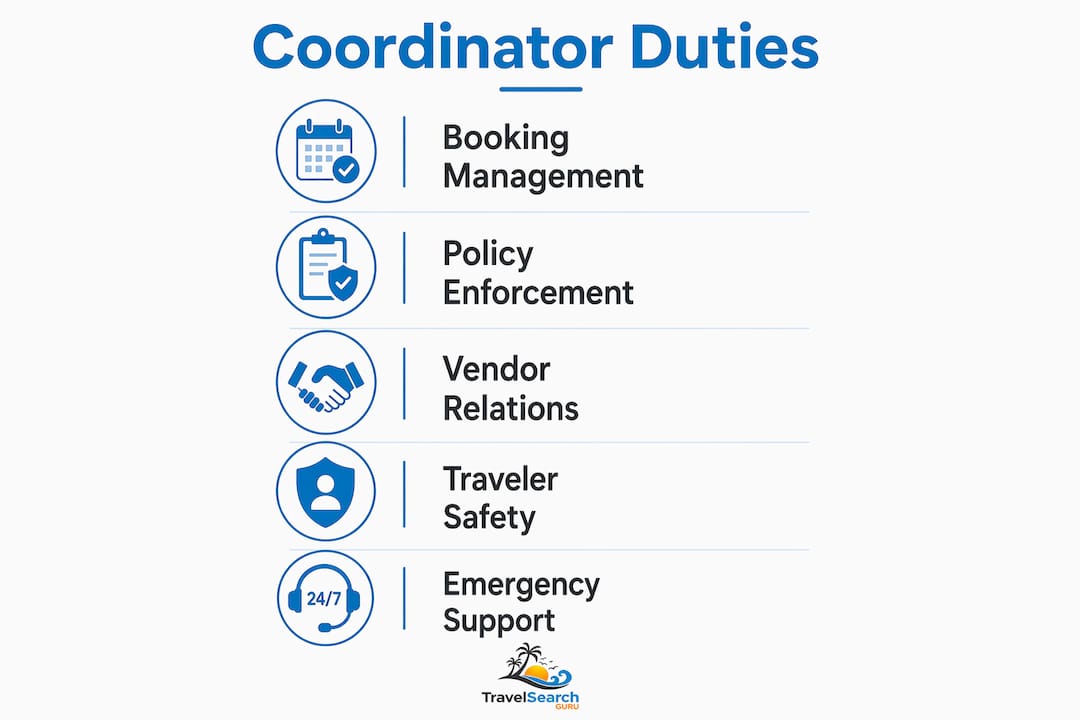
Travel coordinators plan, book, and manage all transportation, lodging, and itinerary logistics within corporate policy while handling real-time disruptions and expense reconciliation. That definition covers a wide operational territory. On any given day, a coordinator might rebook a canceled flight from Punta Cana, negotiate a room block rate at Hilton La Romana, and reconcile three expense reports before noon.
The daily task list for a corporate travel coordinator typically includes:
- Flight and hotel booking within approved vendor lists and per-diem limits
- Ground transportation arrangements, including airport transfers and shuttle coordination at resort destinations
- Itinerary management, including real-time rebooking when schedules change
- Expense tracking and reconciliation against corporate card data
- Vendor communication, including follow-up on group rates and contract terms
- Policy compliance checks before every booking is confirmed
One distinction that matters for larger organizations is the difference between a travel coordinator and a travel manager. Travel managers own strategic policy and vendor relationships, while travel coordinators execute day-to-day bookings and disruption management. Small companies often merge these roles into one position, which increases operational risk when a single person is unavailable during a travel emergency.
Pro Tip: If your organization sends more than 50 travelers per year, separate the coordinator and manager roles formally. Merging them creates a single point of failure that shows up at the worst possible moment.

Automation displaces routine booking tasks but amplifies the coordinator’s role in policy governance, vendor management, and exception handling. This means the job is becoming more strategic, not less relevant, as technology takes over repetitive work.
How does travel coordination uphold duty of care and traveler safety?
Duty of care is the legal and ethical obligation an employer has to protect travelers while they are on company business. Duty of care requires real-time traveler monitoring, multi-channel crisis communication including 24/7 emergency hotlines, and tested alert systems. For corporate trips to the Caribbean and Mexico, where travelers may be in remote resort areas or unfamiliar cities, this obligation carries real operational weight.
The ISO 31030 framework gives organizations a structured way to meet that obligation. Corporate travel risk management per ISO 31030 requires four pillars:
- Governance: Assign clear ownership of travel risk decisions and escalation paths.
- Risk assessment: Evaluate destination-specific threats before travel is approved.
- Monitoring: Track traveler locations in real time using integrated booking data.
- Post-incident review: Document what happened and update protocols after any incident.
Embedding these controls directly into the booking workflow is the most effective way to reduce policy violations. When a traveler books outside the managed platform, the coordinator loses visibility. Booking leaks outside managed platforms cause coordination failures that directly jeopardize duty of care during emergencies.
A 24/7 emergency hotline is not optional for organizations with frequent travelers. Employers must be able to locate and communicate with travelers instantly during emergencies. That requires booking data integration across managed travel agents, direct bookings, and last-minute changes to maintain location accuracy at all times.
Statistic to know: 93% of travelers say travel logistics reduce their ability to relax. That number reflects how directly coordination quality affects traveler wellbeing and, by extension, their performance on the trip.
What makes group corporate trips harder to coordinate?
Group travel coordination is a different problem than individual trip management. Group travel coordination complexity grows exponentially with 20 or more travelers because of cascading schedule and logistics changes. One delayed flight does not just affect one person. It ripples through room assignments, shuttle schedules, dinner reservations, and meeting start times.
The table below shows how coordination demands shift between individual and group corporate travel:
| Factor | Individual travel | Group travel (20+ travelers) |
|---|---|---|
| Itinerary changes | Affects one traveler | Cascades across rooms, transport, and schedules |
| Communication | One point of contact | Requires broadcast and confirmation workflows |
| Vendor negotiation | Standard rates | Group contracts with attrition clauses |
| Tracking complexity | Single booking record | Multiple records across channels |
| Risk exposure | Contained | Multiplied across all travelers simultaneously |
The single most effective structural fix for group travel is assigning one dedicated coordination owner. That person holds all vendor contacts, has authority to make real-time decisions, and serves as the single source of truth for the entire group. Manual workflows create bottlenecks; connected platforms that centralize all bookings eliminate information silos.
For Caribbean and Mexico offsites, this matters even more. A group arriving at Dreams Dominicus La Romana or Hilton La Romana needs coordinated airport transfers, pre-assigned rooms, and a confirmed activity schedule before the first traveler lands. Corporate travel coordination at resorts like Hilton La Romana involves integrating local vendor expertise with global policy to ensure smooth group transitions and events.
Pro Tip: Build your update propagation workflow before you finalize the itinerary. Knowing how a schedule change gets communicated to all 30 travelers in under 10 minutes matters more than having a perfect initial plan.
Group travel coordination should prioritize predefined update propagation workflows over perfect itineraries. A plan that can adapt quickly beats a plan that looks perfect on paper but collapses when one vendor changes a pickup time.
How does technology improve corporate travel coordination?
Technology has changed what corporate travel management looks like at the operational level. AI-assisted booking platforms like Navan and SAP Concur improve efficiency and reduce manual errors by automating policy enforcement at the point of booking. A traveler cannot accidentally book a non-preferred hotel if the platform only shows approved options.
The core benefits of integrating a travel management platform include:
- Policy automation: Approved vendors, rate caps, and approval workflows are enforced without coordinator intervention.
- Centralized vendor management: All contracts, rates, and contacts live in one place, reducing the risk of duplicate bookings or missed renewals.
- Real-time reporting: Program analytics show spend by department, destination, and traveler, giving executives data to negotiate better rates.
- Disruption alerts: Automated notifications reach travelers and coordinators simultaneously when flights are delayed or canceled.
- Duty of care integration: Location data from bookings feeds directly into risk monitoring dashboards.
For Caribbean and Mexico travel specifically, technology integration solves a common problem: local vendors who operate outside global booking systems. A resort activity provider in the Dominican Republic or a private transfer company in Cancun may not appear in Navan or SAP Concur. The coordinator’s job is to bridge that gap by pre-vetting local vendors and loading their details into the central system before the trip begins.
Our team at TravelSearch Guru has seen this gap cause real problems on group trips. When local vendors are not pre-integrated, coordinators end up managing a parallel paper trail alongside the digital platform. That doubles the workload and increases the chance of errors. The solution is to plan business travel logistics with local vendor integration as a non-negotiable step, not an afterthought.
Technology also changes the coordinator’s role in a meaningful way. Routine bookings get automated. What remains is judgment: handling the exception that the platform cannot resolve, managing the vendor relationship that requires a phone call, and making the call when a traveler needs to be rerouted at 11 p.m. local time in Punta Cana.
Key takeaways
Effective travel coordination is the single most important factor in whether a corporate trip delivers its intended business outcome or becomes a logistical liability.
| Point | Details |
|---|---|
| Define coordinator duties clearly | Coordinators handle daily bookings, disruptions, and expense reconciliation within policy. |
| Separate roles at scale | Organizations with 50+ annual travelers should split coordinator and manager functions to reduce risk. |
| Build duty of care into booking | ISO 31030 compliance requires governance, risk assessment, monitoring, and post-incident review embedded in workflows. |
| Assign one group travel owner | A single coordination owner eliminates information silos and speeds up decision-making for group trips. |
| Pre-integrate local vendors | Caribbean and Mexico trips require vetting and loading local vendors into central platforms before departure. |
Our team’s perspective on corporate travel coordination
The biggest mistake we see corporate planners make is treating coordination as a booking function rather than a risk management function. Booking is the easy part. Any platform can confirm a flight. The hard part is knowing what to do when that flight cancels at 6 a.m. and 25 executives are supposed to be at a leadership session at Hilton La Romana by noon.
We have worked on group corporate trips across the Dominican Republic, Mexico, and the wider Caribbean for years. The pattern is consistent: organizations that invest in coordination infrastructure before the trip have dramatically smoother experiences than those that try to manage problems reactively. Pre-trip coordination means confirmed ground transportation, pre-assigned rooms, tested emergency contact chains, and local vendor relationships that can be activated on short notice.
One thing we push back on is the assumption that automation solves the coordination problem. Navan and SAP Concur are excellent tools. They handle the routine. But a platform cannot call a resort’s group coordinator at 10 p.m. to confirm that 30 welcome bags are in the right rooms. That takes a person with relationships and authority.
The other underrated factor is the traveler experience itself. 93% of travelers report that logistics stress reduces their ability to relax. For a corporate offsite designed to build team cohesion or reward top performers, that stress directly undermines the trip’s purpose. Good coordination is not just operational. It is what makes the trip worth taking.
Our team’s advice: treat the coordination plan as a living document. Update it every time a vendor changes, a traveler’s details shift, or a new risk emerges at the destination. The plan that works on day one of planning is rarely the plan you execute on day one of travel.
— Our Team at TravelSearch Guru
How TravelSearch Guru supports corporate travel coordination
Corporate travel to the Caribbean and Mexico involves logistics that most booking platforms do not handle well on their own. TravelSearch Guru’s team specializes in exactly that gap: the local vendor relationships, group transfer coordination, and destination expertise that make the difference between a smooth arrival and a chaotic one.

Our airport transfer services are built for corporate group arrivals and departures, with pre-confirmed vehicles, meet-and-greet coordination, and real-time flight monitoring. For groups landing at Punta Cana International Airport or Cancun International Airport, we handle the ground logistics so your coordinator can focus on the bigger picture. Our team also supports complex group itineraries at resorts across the Dominican Republic and Mexico, from Dominican Republic tours and activities to full-group excursion scheduling. If you are planning a corporate offsite in the Caribbean or Mexico, connect with our team to get the coordination infrastructure right from the start.
FAQ
What is the role of travel coordination in corporate trips?
Travel coordination manages all logistics for corporate trips, including flights, hotels, ground transportation, and real-time disruptions, within company policy. It is the function that keeps travelers on schedule, within budget, and reachable during emergencies.
How does a travel coordinator differ from a travel manager?
Travel managers own strategic policy and vendor relationships, while travel coordinators execute day-to-day bookings and handle disruptions. Small organizations often merge these roles, which increases operational risk.
What is duty of care in corporate travel?
Duty of care is the employer’s obligation to monitor traveler safety, maintain real-time location awareness, and provide 24/7 emergency communication during business trips. The ISO 31030 framework provides a structured approach to meeting this obligation.
Why is group corporate travel harder to coordinate?
Group travel complexity grows exponentially with 20 or more travelers because one itinerary change cascades across rooms, transport, and schedules. A dedicated single coordination owner and a connected booking platform are the most effective solutions.
How do platforms like Navan and SAP Concur help with coordination?
Navan and SAP Concur automate policy enforcement, centralize vendor management, and provide real-time disruption alerts. They reduce manual errors on routine bookings but still require a coordinator to manage exceptions and local vendor relationships.